Tax compliance is critical in having a just and steady economic system since it sustains national development and the provision of public services. Compliance is closely monitored by the authorities to avoid loss of revenue and accountability among individuals and businesses. Failure to comply with tax regulations may result in fines and legal actions.
In this context, this blog discovers what is tax evasion Australia, how it differs from tax avoidance and how you can avoid tax evasion risk.
Tax evasion refers to the intentional and unlawful act of avoiding tax obligations. It includes deliberate actions taken to reduce or eliminate tax liability through unfair means. As per the Australian Taxation Office (ATO), tax crime includes activities that abuse the tax system for financial gain. These activities can include hiding income, falsifying records or using complex arrangements to conceal earnings. Such actions may attract serious ATO tax evasion penalties depending on the severity.
There are multiple ways in which individuals and businesses may engage in tax evasion. Some of them include:
These practices are closely examined under ATO rules for undeclared income.
Tax evasion penalties fall under the laws of taxation into legislative and criminal penalties. These are administrative penalties under the Taxation Administration Act 1953 and criminal penalties under the Criminal Code Act 1995. These laws determine how the tax evasion penalty Australia is applied in each case.
The common penalties of tax evasion include:
| Category | Legal Section / Law | Type of Offence | Penalty |
| Administrative Penalties | Taxation Administration Act 1953 (Schedule 1) | False or misleading statements | Up to 75% of the tax shortfall |
| Shortfall Penalties | Taxation Administration Act 1953 | Underreporting income or overclaiming deductions | 25% to 75% depending on intent |
| Criminal Offence – Fraud | Criminal Code Act 1995 (Section 134.2) | Getting a financial advantage by deception | Up to 10 years imprisonment |
| Criminal Offence – False Statements | Criminal Code Act 1995 (Section 135.1) | Providing false or misleading information | Up to 12 months imprisonment |
| Conspiracy Offences | Criminal Code Act 1995 | Agreement to defraud the Commonwealth | Significant fines and imprisonment |
These categories collectively reflect the range of penalties for tax evasion Australia that may apply based on the nature of the offence.
There are mainly four tax evasion laws Australia applies to the taxpayer if they have been found guilty. These sections are as follows:
The offence occurs when someone uses dishonest, deceitful methods to obtain Commonwealth property, which they intend to keep forever. In tax-related matters, this usually refers to money owed as tax, though it can also include other financial assets.
The provision applies to situations where a person files a tax return with false information to decrease their tax liability, which results in them keeping government funds. Conviction under this section may lead to a penalty of up to ten years in prison. Courts may also impose fines for tax evasion Australia, depending on the case.
This section covers instances where an individual exploits dishonest means to obtain a monetary gain from a Commonwealth entity. Different from the last offence, the emphasis here is on getting a benefit from unlawful tax returns. Typical instances of deception are attempting to get a tax refund or benefits that you are not entitled to, either for yourself or for someone else. Section 134.2(1) consequences of tax evasion Australia are up to ten years of imprisonment.
The offence applies when someone obtains a financial benefit from a Commonwealth entity unlawfully. Usually, it is considered a lesser offence as compared to those involving deception under section 134.2(1). A conviction can lead to a maximum penalty of 12 months’ imprisonment. It may also involve ATO penalties for incorrect tax returns.
This crime occurs when two or more individuals reach a mutual agreement to work together with a view to dishonestly incurring a loss to a Commonwealth organisation. The crime is based on agreement and intent. In accordance with Section 135.4, the prosecution is not required to demonstrate that you were aware that the defrauded party was a Commonwealth entity.
Every member of the contract may be legally liable to the actions performed within the conspiracy. In some cases, this may also relate to penalties for not declaring income Australia if income concealment is involved. On conviction, this is a maximum 10-year imprisonment offence.
Besides the administrative and criminal consequences, tax evasion may result in four financial effects on the individual found guilty of unlawful business accounting. These are as identified below:
Professional support, such as tax advisory service, can help assess risks and manage financial exposure in such situations.
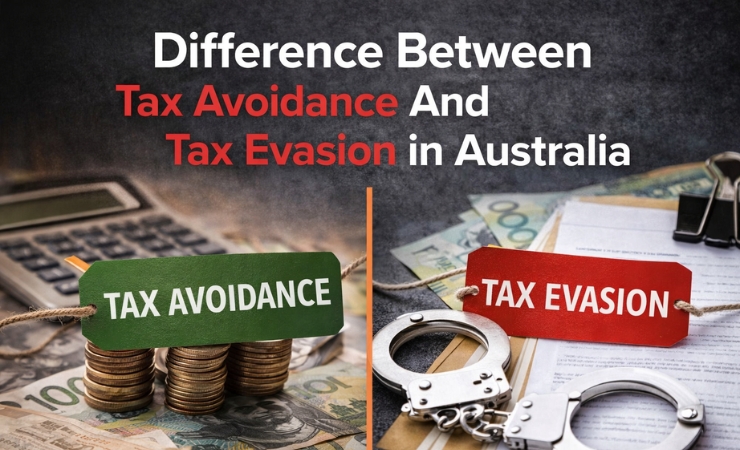
| Basis of Comparison | Tax Evasion | Tax Avoidance |
| Meaning | Involves deliberately avoiding tax through illegal methods such as hiding income or falsifying records | Involves legally reducing tax liability using permitted deductions, exemptions, and planning strategies |
| Legality | Illegal and punishable under the law | Legal if done within the framework of tax laws |
| Intent | Involves intentional deception or fraud | Involves lawful tax planning without deception |
| Nature of Action | Concealment, misrepresentation, or non-disclosure of income | Structured business tax planning to minimise tax within legal limits |
| Consequences | Can lead to penalties, fines, and imprisonment | No penalties if compliant |
| Example | Not reporting income or claiming false deductions | Claiming eligible deductions or using tax offsets |
The right approach that can be used to avoid penalties and legal complications is to remain tax compliant with the tax laws. The following are some of the best practices that can be taken with the help of a tax accountant:
Legal advice may become essential if there is a risk of investigation and allegation of tax evasion. An accounting firm in Perth can assist you with responding to audits, negotiating with authorities and preparing a defence if required. In some instances, a voluntary disclosure before the investigation can reduce penalties.
Also read: How to Plan Your 2026 Business Strategy (A Complete Year-End Guide)
Tax evasion represents a major offence that results in both legal penalties, financial consequences and judicial outcomes. One effective method to prevent such situations requires organisations to maintain accurate records while executing their compliance duties. In this situation, you may need to take assistance from a small business tax accountant to help confirm your adherence to tax regulations. Lastly, responsible tax reporting helps to protect your finances and credibility as a taxpayer.



Copyrights © Palladium Financial Group 2026